
Games
The Architecture of Vulnerability: Why the Bar Counter Is Gaming's Ultimate Confessional
From VA-11 Hall-A and Coffee Talk to Risouverse: Blindspot, explore how the physical barrier of a bar counter creates gaming's most intoxicating, vulnerable narrative encounters.

The Counter as an Emotional Sanctuary: The Spatial Psychology of Interactive Bartending
In video game architecture, physical barriers are almost universally designed to separate combatants, deflect incoming fire, or delineate hostile territory. Yet in the quiet subgenre of narrative bartending games, a polished slab of mahogany accomplishes the exact opposite: it becomes the ultimate sanctuary for human intimacy. The bar counter establishes a singular psychological dynamic that traditional face-to-face role-playing encounters cannot replicate. Sitting directly across from another person in an open room creates an inescapable spotlight of scrutiny, frequently triggering social anxiety and guarded posturing. Behind a bar counter, however, the geometry of interaction changes completely. The counter provides an architectural buffer—a designated boundary of professional safety that grants patrons permission to occupy space without demanding immediate defense. Eye contact is intermittent and organic rather than confrontational; the bartender is perpetually engaged in the tactile rhythm of wiping glasses, polishing brass, or measuring spirits, giving the guest room to gaze into their glass and think. Furthermore, the bartender occupies a timeless archetype: a neutral confidant bound by unspoken confidentiality, possessing no personal stake in the patron's external social hierarchy. Patrons confess secrets to a bartender that they would hide from spouses, therapists, or corporate superiors precisely because the counter establishes both closeness and insulation. This delicate equilibrium transforms the bar counter into an interactive confessional, where the simple act of pouring a drink opens emotional reservoirs that sprawling open-world quest trees can never reach.
Glitch City to Seattle: How VA-11 Hall-A and Coffee Talk Redefined In-Game Intimacy
The artistic power of counter-based storytelling was etched into indie gaming history through Sukeban Games' cyberpunk masterpiece VA-11 Hall-A: Cyberpunk Bartender Action. Set in the dystopian sprawl of Glitch City, the game cast players not as a cyborg vigilante dismantling corrupt syndicates, but as Jill Stingray, an ordinary young woman tending bar at a decaying downtown dive. VA-11 Hall-A made a revolutionary design choice: it discarded traditional dialogue branching wheels entirely. Instead, player agency was channeled purely through mixology. Altering alcohol ratios, serving a sweet Sugar Rush instead of a bitter Piledriver, or deliberately over-serving patron Sei or the private investigator Stella shifted their emotional cadence and unlocked hidden vulnerability. A few years later, Toge Productions captured global hearts with Coffee Talk, transporting this stationary confessional format to an atmospheric fantasy Seattle. As a late-night barista preparing warm cups of matcha, espresso, and ginger tea while rain drummed against the windowpane, players listened to the romantic frictions of an elf and a succubus, the artistic struggles of a freelance journalist, and the quiet anxieties of immigrant orcs. Both landmark titles proved that players did not need sprawling maps or apocalyptic stakes to feel deeply invested in interactive characters. The intimacy emerged from the rhythmic ritual of hospitality: preparing the right beverage, listening with quiet empathy, and letting complex personalities reveal their bruised humanity at their own unhurried pace.
Neo Cab and the Moving Confessional: Contrast with the Fixed Haven
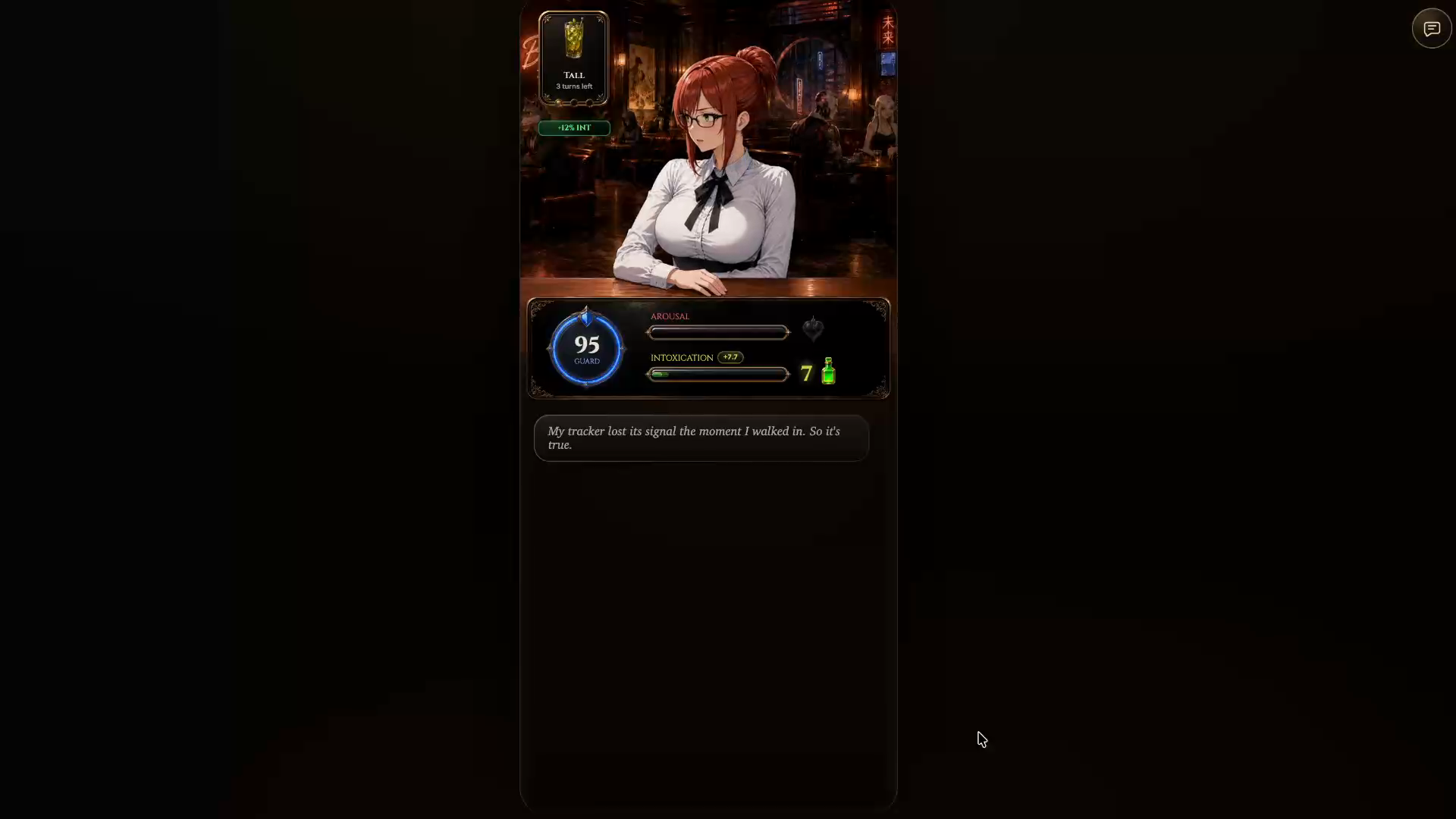
To truly understand why the stationary bar counter remains unmatched in cultivating intimacy, one must examine its mechanical cousin: the moving vehicular confessional. In Chance Agency's brilliant narrative game Neo Cab, players assume the role of Lina, one of the last human rideshare drivers navigating the automated, corporate-dominated city of Los Ojos. Like the bartender behind the counter, Lina sits separated from her passengers by headrests and rear-view mirrors, engaging with strangers who treat the back seat of her cab as a temporary sanctuary. Neo Cab brilliantly gamifies emotional vulnerability through the Feelgrid, an interactive mood bracelet that tracks Lina's psychological spectrum from depressed blue to furious red, directly restricting or opening specific conversational paths. Yet while Neo Cab captures the fleeting, electric intimacy of two souls intersecting briefly in transit, it highlights the unique strength of the stationary bar. A taxi ride is inherently ephemeral and transactional; once the destination arrives, the passenger vanishes into the night, often never to be seen again. In contrast, as depicted in the atmospheric bar counter gameplay in Blindspot (/media/blindspot/source-gameplay.png), the stationary counter becomes a recurring shelter. Patrons return night after night, their emotional arcs unfolding across sequential shifts. The counter endures as an unmoving anchor within a turbulent metropolis, allowing relationships to compound, trust to deepen, and hidden traumas to be dismantled over time.
The Off-Grid Haven: Risouverse: Blindspot and the Tyranny of the Pristine Cage
Risouverse: Blindspot elevates the narrative bartending fantasy to an urgent, high-stakes ideological battle by embedding it within the oppressive dystopia of the Pristine Cage. In this sunlit, golden-hour metropolis, authoritarian control is not exerted through jackbooted police or overt military curfews; it is enforced through algorithmic wellness scoring, constant biometric surveillance, and mandatory social harmony. The five ruling Megacorps—Lumina Veil, Vitalis Form, Aegis Harmony, Vespera Serum, and Nexus Forge—have created a society where negative emotions, messy desires, and raw passions are treated as public health defects. Citizens wear digital wellness trackers that log every elevated heartbeat, flushed cheek, and unscheduled tear, adjusting their Radiance social reputation in real time. In this hyper-optimized panopticon, the Blindspot Network represents the only genuine sanctuary left. Hidden behind Static Wards—specialized physical shielding that renders rooms completely invisible to corporate tracking algorithms—these subterranean speakeasies allow citizens to finally drop the exhausting performance. When a patron slides onto a stool in your Blindspot lounge, they are committing an act of quiet treason. Across your counter sits Voss, an elite Lumina Veil curator exhausted by sanitizing the city feed; Lexi, a cheerful Vitalis Form athletic coach drowning in optimization debt; and Sable, an Aegis Harmony enforcer battling the sensory haze of corporate mood stabilizers. Behind your bar counter, hospitality transforms into an act of revolutionary shelter.
Deconstructing the Armor: Guard, Arousal, and the Path to Lucid Authenticity
What elevates Blindspot above its genre predecessors is its sophisticated systemic simulation of interpersonal psychology. While earlier bartending titles relied on static mood gauges or hidden branching triggers, Blindspot translates conversational tension into a dynamic psychological duel governed by three interwoven metrics: Guard, Arousal, and Intoxication. Patrons do not arrive at your counter ready to bear their souls; they enter with high Guard, actively shielding their corporate vulnerabilities behind practiced irony, sterile corporate jargon, and rehearsed smiles. As the bartender, you navigate this defensive firewall by deploying tactical dialogue cards—Insight, Joke, and Flirt—while carefully calibrating your drink recipes. Playing an empathetic Insight card validates a patron's hidden exhaustion and fractures their defensive Guard. However, attempting a forward Flirt card before their Guard has collapsed triggers instant emotional recoil and defensiveness. Furthermore, craft cocktails act as physiological keys: spirits loosen somatic resistance and elevate Intoxication, but over-serving induces mental fog and risks a catastrophic emotional rupture known as Cascading. Managing Intoxication recovery across turns allows you to guide guests into a rare state of emotional equilibrium. When Guard crumbles and Arousal peaks under balanced conditions, patrons reach Awakening—choosing to discard corporate mood stabilizers and step into Lucid Authenticity. Behind Blindspot's bar counter, serving a drink is not mere role-play; it is an intimate psychological operation that liberates the human soul.
Take your place behind the counter in Blindspot to experience deep narrative intimacy in browser
Sources & further reading
BLINDSPOT
Your shift is waiting.
Blindspot puts you behind the bar in the Risouverse. Talk to your guest, mix drinks, and watch how the conversation changes.
Play BlindspotRomantic Visual Novel · Browser demo · Sign-in required