
Games
Beyond the Love Interest: The Best Games with Deeply Interactive Female NPCs
Examining how Baldur's Gate 3, Cyberpunk 2077, The Witcher 3, and Risouverse: Blindspot revolutionized interactive female characters through complex agency, flaws, and psychological depth.

The Death of the Trophy: How Interactive Female Characters Grew Up
For much of gaming history, female non-player characters occupied a depressingly narrow creative spectrum. They were damsels waiting patiently at the end of a castle dungeon, decorative quest-dispensers, or checklist romance interests designed to validate the player's heroic ego. In classic role-playing games and traditional dating simulators, romancing a female character rarely demanded emotional intelligence or genuine curiosity about her inner life. Instead, it operated as a mechanical transaction: exhaust every branching dialogue tree, present her with preferred gift items, agree with every opinion she voiced, and collect an affection reward. Fortunately, the last decade of narrative game design has witnessed a profound creative renaissance. Modern writers and game directors realized that players do not want passive fantasy archetypes; they want complicated, autonomous, and sometimes deeply frustrating women whose lives extend far beyond the protagonist's gravitational pull. Contemporary masterworks understand that true interactive depth emerges from sovereignty. A great female companion must possess personal ambitions, moral boundaries, traumatic baggage, and the unconditional agency to say no. When an interactive character pushes back against your conversational shortcuts, questions your motives, or pursues her own ideological agenda regardless of whether it aligns with your desires, she ceases to be a digital puppet. This ongoing paradigm shift has redefined what makes video game storytelling compelling, turning interpersonal dynamics into some of the most memorable artistic experiences in modern media.
Sovereignty and Scars: The Enduring Impact of Yennefer and Shadowheart
Few characters embody this modern ethos of female autonomy as vividly as Yennefer of Vengerberg in CD Projekt Red's The Witcher 3: Wild Hunt and Shadowheart in Larian Studios' Baldur's Gate 3. Yennefer remains an absolute tour de force in character writing because the game refuses to sand down her razor-sharp edges. She is fiercely intelligent, politically cunning, and relentlessly focused on protecting Ciri. Her romance with Geralt is captivating precisely because she never defers to him; their relationship is an exhilarating collision of intellectual equals shaped by decades of mutual trauma, dark humor, and unresolved grief. When Yennefer rejects Geralt's counsel or pursues a dangerous necromantic ritual, she does so with total sovereign conviction. Meanwhile, Baldur's Gate 3 captivated millions of players through the psychological labyrinth of Shadowheart. As a Sharran cleric subjected to systemic memory manipulation and religious indoctrination, Shadowheart begins her journey cloaked in abrasive skepticism and defensive hostility. What makes her interactive arc so groundbreaking is that the player cannot simply 'fix' her through persistent flattery. Unraveling her manufactured faith requires monumental patience, empathetic observation, and respect for her personal boundaries. If you push her too hard before she is ready to confront the truth of her past, she will withdraw entirely. Shadowheart's brilliance lies in her hard-won autonomy: in her most pivotal narrative moments, the most powerful choice the player can make is to step back and let her decide her own fate.
Raw Humanity in the Neon Dust: Judy Alvarez and Panam Palmer
In Cyberpunk 2077, Night City is a hyper-capitalist meat grinder that devours human sincerity, which makes the searing emotional vulnerability of Judy Alvarez and Panam Palmer hit with devastating impact. Judy, the Mox-affiliated braindance technician, stands out as one of the most authentically written women in speculative fiction. Her entire character arc is driven not by corporate ambition or mercenary greed, but by raw grief, righteous indignation, and an aching desire to protect the vulnerable. The intimacy players share with Judy during the quiet, submerged exploration of her childhood hometown in 'Pyramid Song' remains an industry benchmark for interactive storytelling. Her emotional presence feels tangible because the game allows her to mourn, to fail, and to express profound exhaustion with the brutality of her world. In sharp contrast, Panam Palmer brings the fiery, uncompromising independence of the Nomad badlands. Her fiery temper, fierce loyalty to the Aldecaldos family, and deep reluctance to let down her guard make every hard-won moment of shared trust feel intensely earned. Neither Judy nor Panam exists merely to orbit the player's legendary mercenary persona. If your values clash with theirs, or if you treat their trust with casual disregard, they will sever ties without hesitation. By grounding these women in believable material struggles, specific subcultural idioms, and uncompromising moral codes, Cyberpunk 2077 demonstrated that companion interactivity reaches its zenith when characters are allowed to remain beautifully, messily human.
The Women of Risouverse: Blindspot: Surviving the Pristine Cage
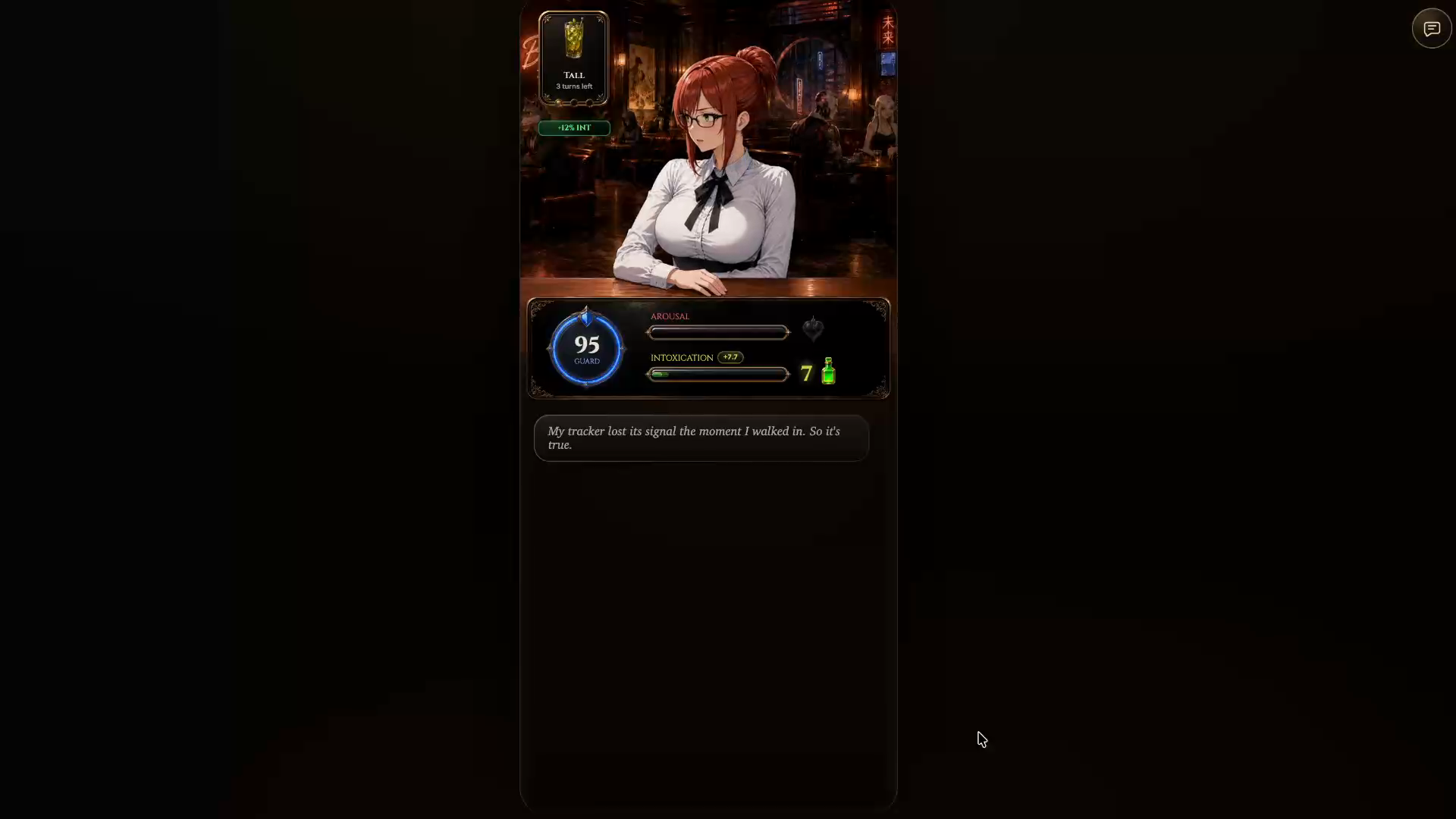
Building upon this legacy of nuanced character design, Risouverse: Blindspot introduces a quartet of deeply compelling female characters who must navigate the insidious psychological tyranny of the Pristine Cage. In this hyper-optimized future, society does not persecute deviance through overt violence; instead, it enforces conformity through corporate wellness trackers, Radiance scoring, and Vespera Serum mood stabilizers. As showcased in the in-game counter interface (/media/blindspot/source-gameplay.png), players step behind a shielded bar counter to interact with women carrying immense corporate baggage. Voss, a Celestial curator for Lumina Veil, sports sharp red heels, audit seals, and spectacles while methodically scrubbing the public feed of raw human expression. Yet behind her immaculate corporate calm lies a suffocating boredom and a secret fascination with the unpolished truths she is paid to erase. Across the counter sits Lexi, a vibrant Vitalis Form coach whose sunny smile and daylit gym persona mask a paralyzing terror of failure and generational optimization debt. Then there is Sable, an Aegis Harmony field compliance officer of Therian lineage whose copper feline fur, tailored audit suit, and glowing neural collar belie the fierce, sensory hunger she numbs every day with corporate dampeners. Finally, Lyra, a purple-haired synthetic holo idol engineered by Nexus Forge, grapples with terrifying unscripted emotions and Echo residue that could result in total memory severance. None of these women are passive romantic prizes; they are guarded survivors of an oppressive utopia.
Breaking the Firewall: Empathy, Mixology, and Lucid Authenticity
What truly distinguishes Blindspot from traditional companion-driven titles is its rigorous, systemic approach to interpersonal connection. Rather than relying on binary approval meters, Blindspot structures every counter shift around three dynamic psychological stats: Guard, Arousal, and Intoxication. Patrons do not sit across your bar waiting to be charmed by generic compliments; they enter with high Guard, actively shielding their corporate vulnerabilities behind irony, deflection, and polite professional jargon. Interacting with them requires genuine emotional intelligence, situational awareness, and observant mixology. By serving bespoke cocktails tailored with specific base spirits, botanical mixers, and alcohol proof, you subtly lower their somatic defenses without inducing drunken incoherence or cognitive fog. Simultaneously, you play tactical dialogue cards—deploying empathetic Insight to validate their hidden trauma, or a well-placed Joke to puncture suffocating tension. Only when a woman's Guard has collapsed does a daring Flirt card ignite genuine romantic electricity. The ultimate narrative goal in Blindspot is not a superficial romance trophy, but guiding these complex women toward Awakening—the courageous, high-stakes choice to drop their corporate masks, accept the social penalties of ruined Radiance scores, and embrace Lucid Authenticity. Experiencing these moments of unscripted truth behind the bar counter proves that the future of interactive storytelling belongs to female characters who fight fiercely for their own souls.
Meet Voss, Lexi, Sable, and Lyra by playing Blindspot in your browser right now
Sources & further reading
BLINDSPOT
Your shift is waiting.
Blindspot puts you behind the bar in the Risouverse. Talk to your guest, mix drinks, and watch how the conversation changes.
Play BlindspotRomantic Visual Novel · Browser demo · Sign-in required