
Games
Beyond the Honeymoon: Top Deep Relationship Games That Master Emotional Connection
From the quiet domesticity of Haven and Florence to the psychological awakenings of Blindspot, explore games that treat intimacy as vulnerability, labor, and earned trust.

The Illusion of Romance: Why Traditional Video Game Relationships Feel Hollow
Video game romance has spent decades trapped in an adolescent fantasy loop. In traditional role-playing games and dating simulators, forming a relationship is almost universally presented as a transactional conquest. The player showers an NPC with their favorite gifts, selects the most sycophantic dialogue choices, completes a personalized loyalty quest, and is rewarded with a climactic love confession, a static kiss illustration, and a permanent affinity stat boost. Once unlocked, the relationship freezes in amber; there is no ongoing domestic labor, no ideological friction, no fear of emotional exposure, and no danger of growing apart. This gamified checklist approach completely ignores the actual architecture of human intimacy. Real-world emotional connection is not an achievement trophy unlocked through good behavior; it is an ongoing, fragile, and often terrifying practice of mutual vulnerability. True intimacy requires allowing another person to see your uncurated flaws, your irrational insecurities, and the shameful compromises you make just to survive. As narrative gaming matures, players are increasingly rejecting superficial romance tropes in favor of stories that explore the complex, messy realities of adult connection, where love is not a victory condition, but a daily act of courage.
Everyday Intimacy and the Labor of Love: Lessons from Haven and Florence
Two groundbreaking indie titles demonstrated that the most powerful depictions of romance arise from quiet, everyday domesticity and wordless empathy. In The Game Bakers' Haven, players control Yu and Kay, an established couple who have abandoned their home world to live in exile on a fractured, abandoned planet. Unlike traditional games that end when two characters confess their feelings, Haven begins long after the honeymoon phase. The brilliance of the game lies in its focus on relational maintenance: cooking together, cleaning their makeshift habitat, nursing each other's battle wounds, and engaging in unscripted banter that balances silly humor with serious anxieties about their future. Haven proves that love is forged in the mundane routines of shared survival. Conversely, Mountains' mobile masterpiece Florence captures the entire lifecycle of a relationship through tactile, non-verbal micro-interactions. In Florence, conversations are represented as jigsaw puzzles: early in the romance, the puzzle pieces are few and fit together effortlessly; as tension and miscommunication mount, the pieces become complex, jagged, and agonizingly difficult to connect. By grounding romance in tactile interaction, both games reveal that deep connection is an evolving dialogue of patience, compromise, and mutual adaptation.
Shared Burdens and Unmasking Trauma: The Psychological Bonds of Persona 5 Royal
When relationship systems delve into psychological trauma and existential despair, bonds transcend romance and become lifelines of survival. In Atlus's Persona 5 Royal, the Confidant system excels not because it offers romanceable heroines, but because every significant bond is founded on a mutual pact of defiance. The protagonist's deepest relationships—whether with the tortured gymnast Kasumi Yoshizawa, the morally compromised detective Goro Akechi, or the grieving counselor Takuto Maruki—are not built on casual flattery. They require the player to confront the profound existential pain, societal alienation, and cognitive defense mechanisms that each character carries. Ranking up a Confidant is not a matter of winning their affection; it is a journey of standing beside them as their idealized social masks shatter, exposing raw grief and unresolved trauma. In the third semester narrative of Royal, connection becomes an ethical crossroads: do you accept an idealized, pain-free reality crafted by a benevolent savior, or do you choose the painful, chaotic truth of real life alongside the people you cherish? Persona 5 Royal demonstrates that meaningful relationships are not forged in comfortable illusions, but in the shared willingness to endure suffering together.
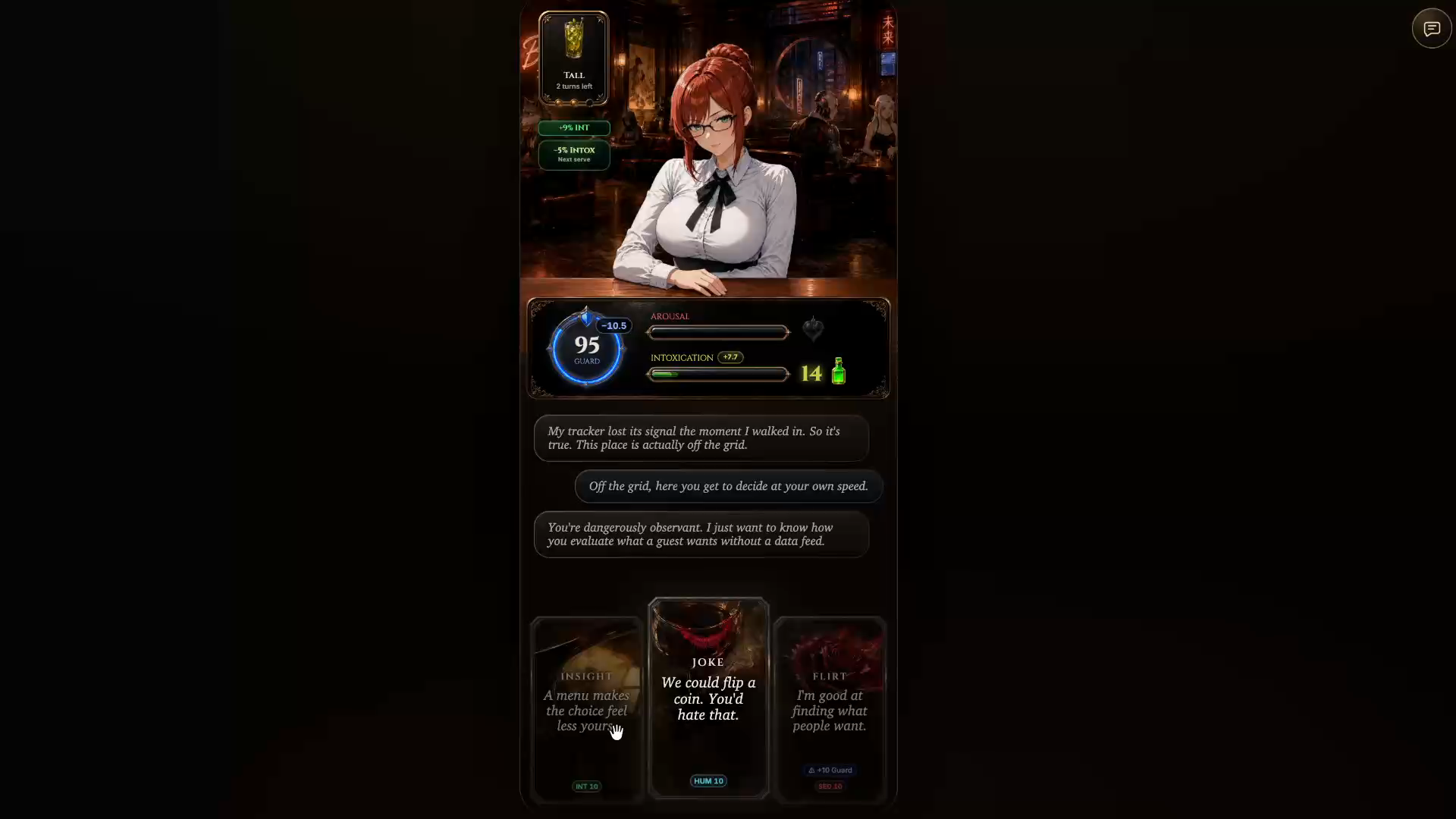
Intimacy as Defiance: The Anti-Optimization Philosophy of Risouverse: Blindspot
Risouverse: Blindspot takes this philosophical exploration of intimacy and places it at the very core of its cyberpunk narrative engine. In the dystopian world of the Pristine Cage, the ruling Megacorps have weaponized the dating checklist into an instrument of totalitarian social control. Citizens are paired through corporate Radiance compatibility algorithms, their heartbeats and dopamine responses are monitored by wellness trackers, and all messy emotional friction is smoothed away by mandatory doses of Vespera Serum. Relationships in the city are perfectly curated, beautifully lit, and completely hollow. Stepping into a Blindspot space is an act of radical emotional heresy. In the signal-dead sanctuary of the underground bar, the player does not pursue characters through gamified checklists. Patrons like Voss, the Lumina Veil archivist suffocating beneath her own immaculate curated reputation, or Lexi, the Vitalis Form coach trapped in an endless loop of forced corporate cheerfulness, do not need flattery. They need a confessor capable of holding their uncurated truth. To connect with them, you must respect their boundaries, deconstruct their heavy Guard with insightful conversation, and demonstrate that their imperfections will not result in rejection.
Lucid Authenticity: Reclaiming Unmedicated, Radical Closeness
The ultimate emotional milestone in Blindspot is not a romantic conquest, but guiding a patron toward Lucid Authenticity. In Risouverse lore, Lucid Authenticity represents the terrifying, exhilarating decision to stop taking Vespera mood stabilizers, cast aside the performance of corporate optimization, and experience human existence with unvarnished honesty. Awakening to this state is not a painless victory; it is a profound sacrifice. A character who embraces Lucid Authenticity watches their Radiance score plummet, risks corporate termination, and faces the reality of unmedicated grief and raw desire. For the player, earning a bond of this depth requires immense emotional discipline. You cannot spam Flirt cards to bypass emotional defenses; you must listen intently to their lineage trauma, soothe their existential fears, and offer unconditional presence behind the bar counter. Blindspot redefines what a deep relationship game can be by showing that authentic intimacy is not about finding someone who complements your status; it is about finding someone in whose presence you can finally lay down your armor. If you are seeking a game that values emotional honesty over easy fantasies, step behind the counter in Blindspot.
Experience authentic emotional connection and play Blindspot in your browser
Sources & further reading
BLINDSPOT
Your shift is waiting.
Blindspot puts you behind the bar in the Risouverse. Talk to your guest, mix drinks, and watch how the conversation changes.
Play BlindspotRomantic Visual Novel · Browser demo · Sign-in required