
World & story
The Cost of Closeness: Why True Intimacy in Video Games Demands Terrifying Sacrifices
Explore how games like Signalis, Slay the Princess, To the Moon, and Risouverse: Blindspot treat profound human connection not as a prize, but as a dangerous, sacrificial act.

The Romance Trap: Why Frictionless Affection Fails Modern Storytelling
For decades, mainstream video game romance has operated on an insidious commercial premise: intimacy as an effortless transaction. In conventional role-playing games and traditional dating simulators, affection functions like an investment portfolio. You offer the right conversational gifts, select predictable dialogue choices that flatter a companion's ego, and watch a digital loyalty meter tick upward toward an inevitable romantic reward. Yet this mechanical design strips intimacy of its most defining human characteristic—the absolute terror of exposure. Real closeness is not a frictionless triumph; it is an existential risk where opening yourself up to another person inherently threatens the psychological armor you constructed to survive.
When interactive fiction sanitizes vulnerability into a guaranteed progression path, it robs relationships of genuine emotional resonance. True intimacy requires friction. It demands that a character willingly dismantle their self-protective boundaries, knowing full well that being deeply understood grants the other party the power to wound them irreparably. Modern narrative games are increasingly rejecting transactional romance in favor of stories where closeness carries a devastating price tag. These games understand that to love someone without compromise requires surrendering control, relinquishing certainty, and often sacrificing the safe social identities that previously kept you insulated from the world. As narrative design matures, the most unforgettable romantic journeys are no longer those that promise effortless happily-ever-afters, but those that force players to confront what they must tear down within themselves to let another living soul cross their threshold.
The Agonizing Devotion of Signalis and To the Moon
Few contemporary titles illustrate the sacrificial ledger of devotion more vividly than rose-engine's psychological survival horror masterpiece, Signalis. The journey of L-283 Elster through the bio-mechanical nightmare of S-23 Sierpinski is not a heroic crusade, but an agonizing pilgrimage to honor a promise made to Ariane Yeong. Here, intimacy is inextricably bound to physical disintegration, psychic contamination, and temporal decay. Elster literally tears her synthetic flesh apart, enduring cycle after cycle of cosmic dread and sensory trauma, solely to reach the cryo-pod of the woman she loves. Closeness in Signalis offers no safe harbor; it is a relentless, reality-bending gravity that consumes identity until only raw, painful devotion remains anchored amidst the void.
In a strikingly different aesthetic realm, Kan Gao's celebrated narrative adventure To the Moon explores an equally crushing sacrifice of connection. Through the memory-altering machinery of Sigmund Corp, players delve into the dying mind of Johnny Wyles to fulfill his final wish. What unfolds is not a nostalgic romance, but a heart-rending deconstruction of how miscommunication, neurodivergence, and grief complicate authentic partnership. To craft a pristine romantic culmination for Johnny, the narrative forces players to confront the tragic erasure of his genuine memories with River. Love in To the Moon is not an untarnished fairy tale; it is an enduring ache shaped by the painful compromises human beings make when trying to bridge the unbridgeable gulf between two isolated consciousnesses.
Deconstructing the Self in Slay the Princess
Black Tabby Games' psychological horror visual novel Slay the Princess strips the hero-and-damsel trope down to its raw existential sinew, turning the act of mutual perception into a terrifying struggle for meaning. Tasked by an imperious Narrator with murdering a captive princess in a remote cabin, every choice the player makes actively reshapes her nature and your own. If you approach her with weaponized suspicion, she becomes a monstrous nightmare; if you attempt to manipulate her, she twists into an uncanny specter of your own deception. The game brilliantly posits that intimacy is an act of co-creation—you cannot perceive another person without projecting your fears and defenses onto them.
Reaching any genuine understanding with the Princess requires disarming yourself entirely, enduring psychological humiliation, and accepting total vulnerability. You must drop your blade, endure death after horrific death, and strip away the comfortable narrative certitude whispered by the Narrator's voices. The climax of this recursive journey reveals that love is not about dominion, containment, or easy harmony. It is the mutual willingness to be dismantled and rebuilt alongside another entity, accepting that true connection necessitates the terrifying dissolution of the static, safe self. Slay the Princess proves that the highest form of intimacy is the courage to stand naked before the shifting void of another consciousness and refuse to strike first.
The Pristine Cage: Comfort as the Executioner of Passion in Risouverse
Nowhere is the philosophical cost of human closeness examined with greater systemic nuance than in the overarching lore of Risouverse. Set within a hyper-optimized utopia bathed in permanent golden-hour lighting, society is governed by five towering Megacorps that arose from The Softening—a historical epoch where exhausted populations willingly surrendered emotional volatility in exchange for peace and stability. In this corporate-curated civilization, known to dissidents as the Pristine Cage, raw passion has been quietly pathologized. The public feed, managed by Lumina Veil, amplifies only manicured wellness milestones and compatible relationship scores, while Vespera Serum pharmaceuticals chemically smooth the jagged peaks and valleys of organic feeling.
Within this gleaming dystopia, citizens have plenty of relationships, yet almost no authentic intimacy. Partnerships are vetted by biometric tracking and algorithmic Radiance scores, ensuring that no sudden burst of unfiltered grief, anger, or irrational desire disrupts civic productivity. To feel something messy or unoptimized is to commit social suicide; your tracker registers the biometric spike, your social standing dips, and corporate wellness consultants arrive with soothing smiles to adjust your medication. The tragedy of the Pristine Cage is not brute oppression, but voluntary emotional anesthesia. The corporate state realized that if you eliminate friction, you eliminate suffering—but you also annihilate the very spark that makes two human beings truly matter to each other.
The Awakening Sacrifice: Guard, Echo, and Social Annihilation in Blindspot
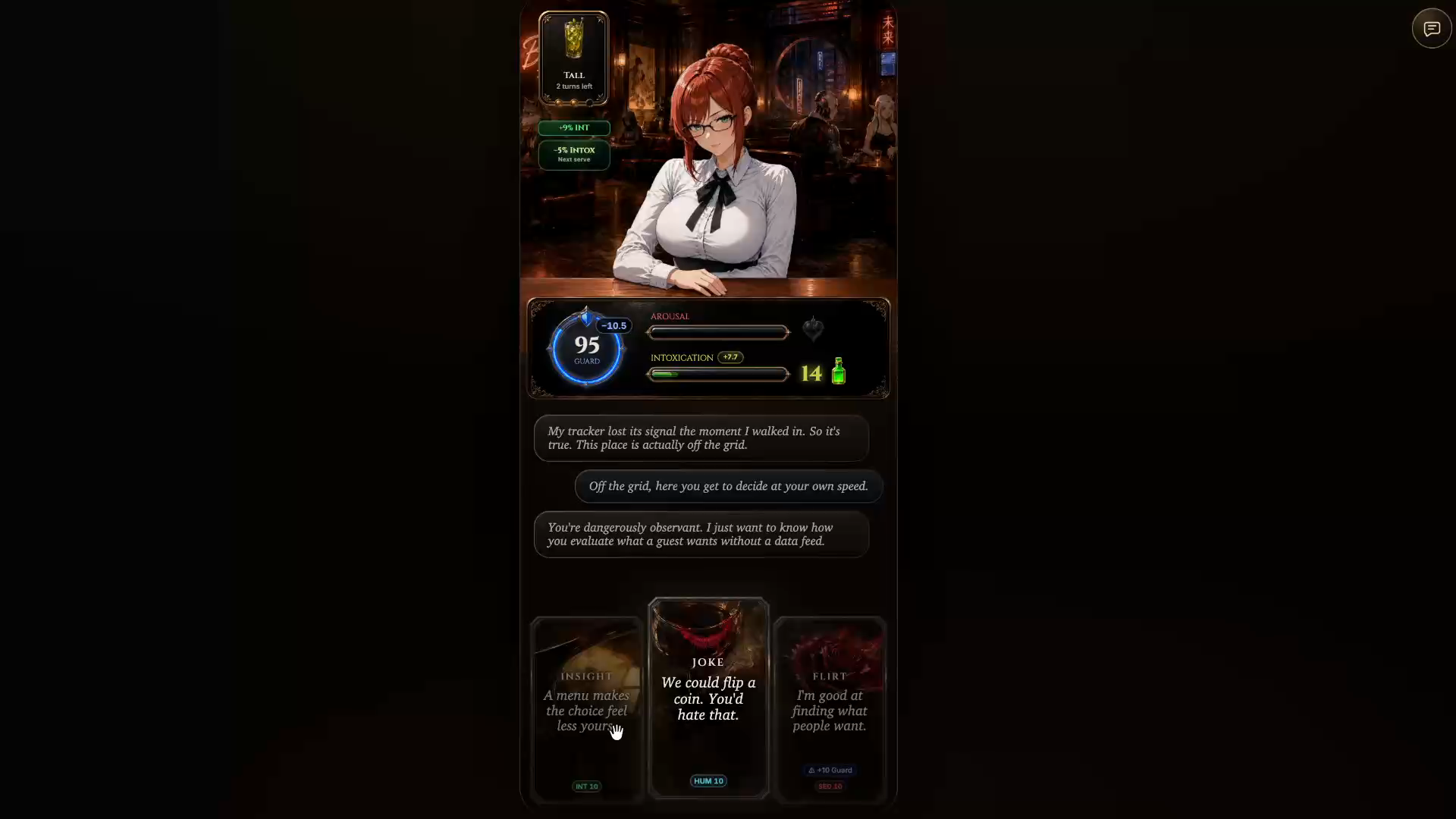
This ideological conflict comes to an explosive head behind the counter in Risouverse: Blindspot. Operating within an underground safehouse protected by Static Wards, players step into the role of a bartender managing the Blindspot Network—an off-grid sanctuary where corporate citizens seek asylum from perpetual performance. The gameplay dismantles traditional romance loops through three reactive psychological meters: Guard, Arousal, and Intoxication. Patrons arrive armored in corporate personas. By mixing custom cocktails with potent spirits and mixers, and playing tactical dialogue cards spanning Insight, Joke, and Flirt, players chip away at their visitor's defensive Guard without tipping them into panicked withdrawal.
The narrative climax of these encounters hinges on the Awakening mechanic. Guiding a patron—such as Sable, an Aegis Harmony compliance auditor suffocating behind her polished ivory uniform—toward true intimacy requires them to make an irreversible sacrifice. They must choose to stop taking Vespera Serum, allow their internal suppressed trauma to surface, and speak with unfiltered candor. This radical honesty is mechanically fraught: swallowing decades of emotional pain generates psycho-reactive Echo, which threatens to trigger a catastrophic Cascade breakdown that manifests as a lethal Phantom. If they achieve Lucid Authenticity, their wellness tracker flashes scarlet, their corporate Radiance score is annihilated, and they are marked as deviants. Blindspot elevates intimacy to its ultimate narrative truth: genuine love does not guarantee happiness—it demands the courage to burn your safe world to ash.
Enter the Blindspot Safehouse and Experience Uncompromising Romance in Your Browser
Sources & further reading
BLINDSPOT
Your shift is waiting.
Blindspot puts you behind the bar in the Risouverse. Talk to your guest, mix drinks, and watch how the conversation changes.
Play BlindspotRomantic Visual Novel · Browser demo · Sign-in required