
Games
Words as Weapons: The Top Conversational Games Where Dialogue Is the Ultimate Combat System
From Disco Elysium and Griftlands to Pentiment and Risouverse: Blindspot, discover the best narrative games where psychological wits and dialogue choices replace swords and guns.

The Verbal Battlefield: Why Dialogue Systems Are Gaming's Most Compelling Combat
For decades, the video game industry operated under an unspoken design dogma: when stakes are high, words must give way to weapons. Spoken dialogue was traditionally treated as narrative connective tissue—the expository prelude or celebratory aftermath sandwiched between shooting galleries, sword fights, and boss battles. When conversational options did appear, they were largely passive: branching dialogue wheels that allowed players to interrogate an NPC for quest clues or select an obviously correct moral choice that awarded positive karma. Too often, games treated conversations like transactional vending machines where inserting polite coins reliably dispensed faction rewards. However, a revolutionary shift in game design has proven that a tense, high-stakes conversation can be vastly more suspenseful, intellectually demanding, and emotionally devastating than any kinetic combat encounter. When two people square off in a verbal duel, every word carries weight. A misplaced question can shatter fragile trust, a poorly timed joke can provoke defensive hostility, and an observant rhetorical insight can dismantle an opponent's ideological armor. Conversational combat taps into psychological vulnerabilities that a broadsword cannot touch: pride, shame, hidden trauma, and the desperate yearning for validation. By translating interpersonal dynamics into systemic battlegrounds with measurable psychological stakes, modern narrative designers have transformed dialogue from a passive storytelling vehicle into the medium's most electrifying combat frontier.
The Modern Masters of Rhetoric: Disco Elysium, Griftlands, and Deus Ex
The benchmark for modern dialogue combat was established by a trio of games that dared to treat social interaction with the mechanical complexity of an RPG battle system. ZA/UM's Disco Elysium remains an unmatched masterpiece, discarding traditional physical combat entirely in favor of a sprawling psychological civil war waged inside the protagonist's fractured psyche. Twenty-four distinct internal skills—from razor-sharp Rhetoric and empathetic Empathy to volatile Half Light and insidious Drama—pipe up during conversations, debating strategies, providing unprompted psychological analysis, and occasionally driving the detective into catastrophic conversational disasters through the Thought Cabinet. Meanwhile, Klei Entertainment's Griftlands took a radically direct structural approach by introducing two separate card-battling deck systems: one for physical brawls and one for high-stakes verbal negotiations. In Griftlands, players play diplomacy and coercion cards to attack opponent arguments, shield their own composure, and manipulate intent, proving that rhetoric could sustain deep, strategic deckbuilding mechanics. Additionally, Eidos-Montréal's Deus Ex: Human Revolution and Mankind Divided introduced memorable social boss battles, where the CASIE neural implant analyzed biometric pulse and psychological profiles, challenging players to read conversational subtext and tailor behavioral arguments to prevent hostage executions or de-escalate political crises. These titles proved that rhetoric could generate unmatched tactical thrill, rivaling any tactical shooter in raw tension.
Subtle Inquisitions: Interpersonal Warfare in Pentiment and Oxenfree
While titles like Griftlands emphasize explicit card mechanics, other visionary studios demonstrated that dialogue combat achieves its greatest intensity through subtle, naturalistic tension. In Obsidian Entertainment's historical mystery Pentiment, director Josh Sawyer crafted a murder investigation in sixteenth-century Bavaria where conversation carries immense sociopolitical gravity. There are no combat dice or glowing health bars; instead, every conversational gambit is weighed against the protagonist's chosen academic background, religious rhetoric, and social standing. Contradicting a high-ranking Benedictine abbot or patronizing a grieving peasant permanently alters their perception, silently locking away crucial investigative paths and deciding who hangs at the gallows. Concurrently, Night School Studio's Oxenfree revolutionized conversational rhythm through its real-time walk-and-talk speech bubbles. By giving players the freedom to interrupt companions, respond mid-sentence, or remain entirely silent, Oxenfree turned conversational timing itself into a weapon. Awkward silences, deliberate hesitations, and sudden interruptions create authentic emotional friction, proving that conversational combat does not require complex menus when timing and human nuance are simulated with precision. Furthermore, Oxenfree highlights how unsaid words can inflict deeper wounds than direct insults, weaponizing adolescent social estrangement into terrifying spectral feedback. As showcased in Blindspot's tactical dialogue UI (/media/blindspot/source-choices.png), this legacy of psychological tension has laid the groundwork for an entirely new wave of systemic, card-driven conversational combat where every sentence carries permanent interpersonal consequences.
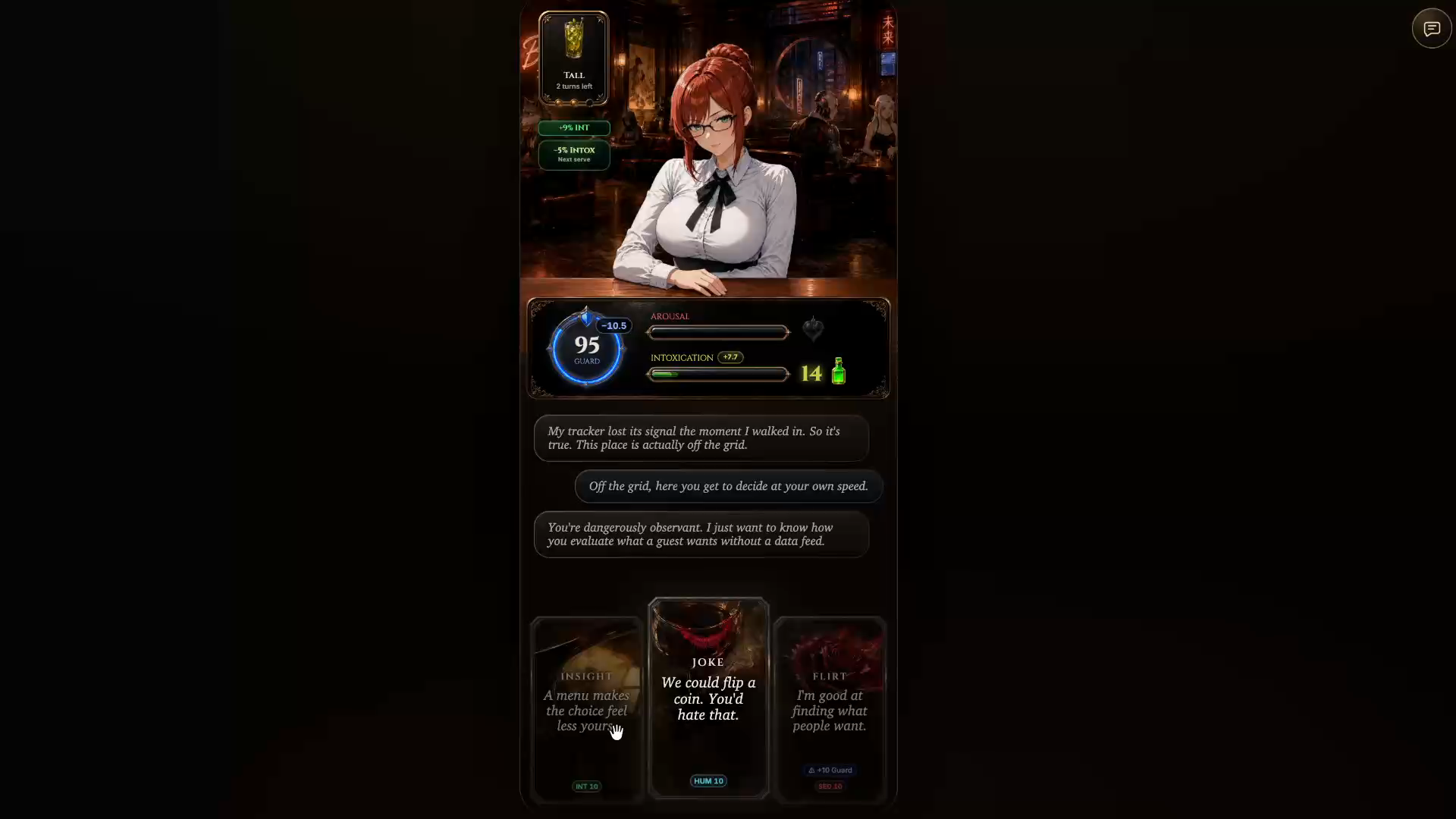
Risouverse: Blindspot: Card-Based Psychological Duels Behind the Bar
Risouverse: Blindspot brings this evolution of dialogue combat to an unprecedented peak by framing every interaction across a speakeasy counter as a high-stakes psychological duel. Set in the dystopian Pristine Cage, where corporate wellness trackers and Radiance scores enforce mandatory cheerfulness, visitors to your off-grid Blindspot bar arrive wrapped in formidable psychological armor. This armor is mechanically visualized through the patron's Guard threshold—a defensive corporate firewall that deflects emotional vulnerability and shields hidden trauma. Players engage in conversational combat by drawing and playing tactical dialogue cards sorted into three primary archetypes: Insight, Joke, and Flirt. Each card operates with strict strategic parameters. Playing an empathetic Insight card cuts through corporate jargon, targeting the patron's unspoken fatigue to deal massive damage to their Guard. However, if the room's tension spikes too high, the player must pivot, deploying a witty Joke card to diffuse anxiety, reset defensive posturing, and prevent cognitive overload. Flirt cards represent the ultimate high-risk, high-reward offensive plays: if attempted while a patron's Guard remains high, they provoke icy sarcasm and instant emotional shutdown. Only after Guard has been systematically dismantled below critical thresholds does a Flirt card ignite breathtaking romantic chemistry, dramatically scaling the patron's Arousal metric and unlocking genuine emotional intimacy.
High-Stakes Consequences: Somatic Mixology and the Triumph of Lucid Authenticity
What cements Blindspot as the pinnacle of conversational combat is its integration of somatic mixology with permanent narrative consequences. Dialogue in Blindspot does not happen in a vacuum; it is synchronized with the drinks you prepare behind the counter. Serving craft cocktails composed of specific base spirits and botanical mixers alters the patron's Intoxication meter in real time. Moderate Intoxication accelerates Guard degradation, creating vulnerable conversational openings where tactical dialogue cards land with enhanced impact. However, careless mixology or reckless conversational aggression can push a guest over the edge, triggering a devastating psychological breakdown known as Cascading. In the world of Risouverse, a Cascade event means the patron loses total emotional control, potentially alerting Aegis Harmony compliance squads and destroying their corporate standing forever. To achieve true victory, the bartender must balance drink proof with Intoxication recovery across turns, carefully steering the duel until the patron's Guard is completely extinguished while their cognitive clarity remains intact. Winning this conversational battle unlocks Awakening—the patron's courageous decision to reject corporate mood stabilizers and embrace Lucid Authenticity. In Blindspot, dialogue combat is not about defeating an enemy; it is about fighting fiercely alongside them to rescue a living human soul from corporate numbness and societal sterility.
Test your wits in high-stakes conversational combat by playing Blindspot in your browser now
Sources & further reading
BLINDSPOT
Your shift is waiting.
Blindspot puts you behind the bar in the Risouverse. Talk to your guest, mix drinks, and watch how the conversation changes.
Play BlindspotRomantic Visual Novel · Browser demo · Sign-in required