
Games
Beyond the Illusion of Choice: Branching Dialogue and Lasting Consequences in Modern Narrative Games
From Telltale's binary forks to Detroit: Become Human's sprawling flowcharts and Blindspot's psychological combat, explore how games transform dialogue into profound consequences.
The Illusion of Choice: Why Early Dialogue Systems Left Players Craving Real Stakes
Early narrative gaming made ambitious promises about player agency, but early dialogue architectures frequently relied on smoke and mirrors. When Telltale Games released The Walking Dead in 2012, the now-iconic prompt 'Clementine will remember that' sent chills down players' spines. For the first time, casual conversations felt charged with moral significance and lingering guilt. However, as players revisited earlier episodes or compared playthroughs online, the structural trickery became painfully evident: despite dozens of branching prompts, major narrative junctures inevitably funneled back into the exact same story chokepoints. BioWare faced a comparable dilemma with the legendary morality wheels of Mass Effect. By bifurcating every critical interpersonal dilemma into color-coded Paragon or Renegade choices, conversation frequently devolved into a rote exercise in min-maxing reputation meters rather than organic human connection. Players were trained to select the top-right blue option not because it made contextual narrative sense, but because maintaining an immaculate behavioral score was required to unlock crucial late-game diplomacy checks. This systemic rigidity created an emotional distance: players ceased conversing with characters as living people and began manipulating them as vending machines that dispensed favorable outcomes. While these foundational experiments proved that players desperately yearned for interactive stories where their spoken words mattered, they ultimately highlighted the limitations of treating dialogue as binary railroad tracks. Real human intimacy and conflict are messy, subjective, and volatile, and reducing complex interpersonal psychology to prefabricated moral alignments left modern narrative connoisseurs hungering for games that could deliver genuine conversational jeopardy.
The Flowchart Revolution: Determinism and Structural Scale in Detroit: Become Human
Quantic Dream attempted to solve the problem of narrative consequence not by obscuring the illusion, but by embracing sheer structural transparency. In Detroit: Become Human, director David Cage laid bare the sprawling architecture of branching storytelling by granting players access to explicit post-chapter flowcharts. Every decision, timed hesitation, and conversational misstep was cataloged, visualizing hundreds of discrete permutations and fatal branches. If an investigator failed to read a suspect's stress levels during an interrogation, that failure rippled outward, permanently altering character mortality, public perception, and revolutionary outcomes chapters later. Detroit demonstrated that interactive branching could achieve staggering scale when supported by cinematic production values and unyielding structural determinism. Yet, for all its technical brilliance, Detroit's monumental flowchart architecture revealed an inherent narrative trade-off: structural branching does not necessarily equate to emotional resonance. When narrative consequences are measured primarily through high-stakes binary outcomes—such as whether a character lives, dies, or escapes across a militarized border—the subtle, subterranean shifts of personal trust can easily become lost. A character's internal conviction or quiet disillusionment often mattered less than hitting a quick-time event or uncovering a hidden clue. Furthermore, the sheer mechanical visibility of the flowchart turned narrative discovery into a completionist checklist, encouraging players to hunt down divergent paths rather than sit with the lingering emotional discomfort of their initial choices. The industry learned a vital lesson: building a thousand narrative branches is impressive, but giving a single intimate conversation the gravity to permanently reshape two souls requires a fundamentally different storytelling philosophy.
From Branching Plots to Internal States: The Psychological Turn in Storytelling
In response to the mechanical limitations of cinematic flowcharts, modern narrative designers began redirecting interactive agency inward. Masterpieces like The Witcher 3: Wild Hunt, Disco Elysium, and Baldur's Gate 3 proved that the most unforgettable narrative consequences rarely announce themselves with fanfare or immediate branching alerts. In The Witcher 3, Geralt's conversational decisions with figures like the Bloody Baron or Yennefer carry delayed, ambiguous consequences that mirror the painful complexity of real life. A seemingly minor domestic observation or a quiet refusal to indulge petty cruelty can trigger unforeseen tragedies dozens of gameplay hours later. Meanwhile, Disco Elysium discarded conventional external consequences entirely, transforming conversation into a ferocious psychological civil war waged within the protagonist's fractured psyche. Dialogue choices in Revachol do not just steer external events; they redefine the player's political soul, neurotic coping mechanisms, and fundamental humanity. Similarly, Baldur's Gate 3 achieved unprecedented critical acclaim by grounding its massive dialogue web in the nuanced personal traumas and moral friction of companions like Shadowheart. Conversing with Shadowheart is not about selecting optimal answers to win an affection prize; it is about navigating her deep-seated indoctrination under Shar, respecting her protective hesitation, and gradually providing a safe space where she can question her manufactured reality. In these landmark titles, consequence shifted from macro-level plot forks to micro-level psychological realities. Players were no longer merely deciding what happened next in the physical world; they were actively shaping who their companions became beneath their armor.
Conversational Combat in Risouverse: Blindspot: Guard, Arousal, and Intoxication
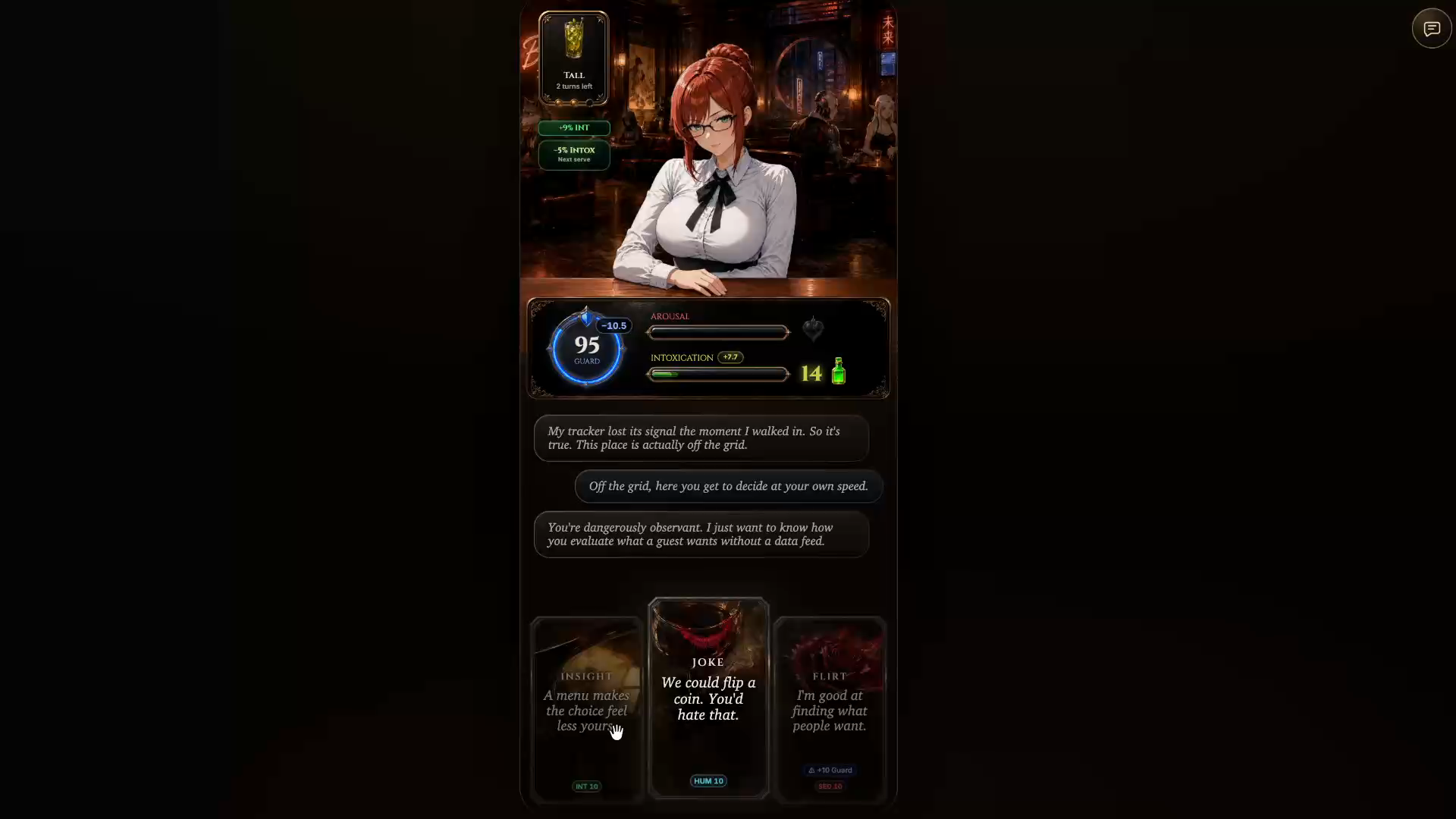
Risouverse: Blindspot takes this psychological evolution to its ultimate frontier by treating dialogue not as a static decision tree, but as a live, tactile conversational duel fought across a shielded speakeasy counter. In the oppressive utopia of the Pristine Cage, citizens are governed by algorithmic surveillance, Radiance social scores, and chemical mood dampeners. When patrons step into the signal-dead sanctuary of a Blindspot bar, their defenses are visualized through dynamic bio-psychological metrics: Guard, Arousal, and Intoxication. Guard represents the patron's corporate firewall—the protective persona cultivated through years of mandatory compliance. As depicted in the in-game dialogue interface (/media/blindspot/source-choices.png), players navigate these encounters by playing tactical dialogue cards sorted into three foundational approaches: Insight, Joke, and Flirt. Mechanically, trying to deploy a seductive Flirt card against an elite Lumina Veil curator like Voss while her Guard remains elevated above eighty percent will fail completely, earning only a scathing corporate reprimand and escalating emotional withdrawal. To make authentic headway, a bartender must observe micro-expressions, pour artisan cocktails with precisely balanced alcohol proof and botanical mixers to loosen somatic tension, and use Insight cards to acknowledge her hidden strain. Furthermore, the Intoxication gauge introduces genuine unpredictability: elevate it moderately and inhibitions soften, but push it too far and you risk cognitive incoherence or a catastrophic public breakdown known as Cascading. Here, choices do not merely steer a dialogue tree; they actively recalibrate a patron's nervous system.
Lucid Authenticity: The High Stakes of Permanent Narrative Breakthroughs
The true brilliance of Blindspot's branching consequences lies in what happens when the conversational dance reaches its emotional climax. Traditional visual novels allow players to freely reload save files to sample every divergent confession without personal cost, turning narrative divergence into disposable entertainment. Blindspot rejects this trivialization by tying conversational outcomes to irreversible psychological transformations. When a player successfully dismantles a patron's defensive Guard without causing them to Cascade into panic, they open the path to Awakening—the terrifying decision to reject corporate mood stabilizers, drop performative perfection, and embrace Lucid Authenticity. For characters like the Aegis Harmony compliance officer Sable or the Vitalis Form coach Lexi, achieving Lucid Authenticity carries staggering in-universe consequences. It means their corporate wellness trackers go permanently red, their pristine Radiance scores plummet, and their employers flag them for subversive deviance. The consequences in Blindspot are not measured in superficial epilogue slides; they are felt in the visceral vulnerability of a woman who has finally stopped lying to herself, her corporate masters, and the world. By fusing the atmospheric intimacy of narrative bartending with rigorous psychological mechanics, Blindspot demonstrates that dialogue choices are most powerful when they demand mutual courage. Step behind the counter, draw your dialogue cards, and discover what happens when you dare to look past the corporate mask and ignite a true revolution of the soul.
Step behind the counter in Blindspot to experience high-stakes conversational consequences firsthand
Sources & further reading
BLINDSPOT
Your shift is waiting.
Blindspot puts you behind the bar in the Risouverse. Talk to your guest, mix drinks, and watch how the conversation changes.
Play BlindspotRomantic Visual Novel · Browser demo · Sign-in required