
World & story
From Damsels to Decision-Makers: The Evolution of Female NPC Agency in Interactive Storytelling
Tracing the historical journey of female agency in video games—from passive quest prizes to autonomous, morally complex heroines in The Witcher, Baldur's Gate 3, and Risouverse: Blindspot.
The Decorative Objective: The Historical Erasure of Female Agency
To appreciate how far narrative game design has advanced, one must look back at the medium's foundational decades, when female characters were almost universally relegated to decorative objectives. In the arcade and eight-bit eras, women existed primarily as plot catalysts: Princess Peach kidnapped by Bowser, Pauline carried to a construction girder, or Marian snatched from the sidewalk in Double Dragon. The female character's role was strictly motivational—she was the prize waiting at the end of an obstacle course to validate the male protagonist's heroic mastery. As games transitioned into three-dimensional story-driven epics in the late nineties and early two-thousands, female representation expanded, but genuine psychological agency remained frustratingly rare. While heroines like Lara Croft proved that women could headline blockbuster action franchises, companion characters in role-playing games were frequently designed as subservient wish-fulfillment fantasies. They orbited the player character's whims, rarely possessed independent moral red lines, and existed in a state of suspended animation until the protagonist initiated conversation. Even in lauded early narrative titles, female characters often lacked sovereign goals that conflicted with the main quest; their loyalties were unconditional, their pasts were malleable, and their philosophical convictions could be easily overturned with a few high-charm speech checks. For decades, video games treated female agency not as an inherent character trait, but as an optional reward bestowed by the player.
The First Fractures: Morrigan, The Boss, and Uncompromising Sovereignty
The shift toward authentic female agency began when courageous narrative designers started creating women who refused to accommodate the player's ego. A seminal turning point arrived with Hideo Kojima's Metal Gear Solid 3: Snake Eater and the towering figure of The Boss. Legendary, formidable, and morally inscrutable, The Boss was not a prize or a sidekick; she was Naked Snake's mentor, maternal figure, and ultimate ideological rival. Her sacrifice remains one of gaming's greatest narrative climaxes precisely because her agency superseded the player's desires: she orchestrated her own tragic martyrdom for a political vision far larger than Snake could comprehend. Concurrently, BioWare shattered conventional companion dynamics with Morrigan in Dragon Age: Origins. Sarcastic, ruthlessly pragmatic, and fiercely protective of her independence, Morrigan fundamentally rejected the hero's moral crusading. She did not seek redemption, nor did she compromise her pursuit of ancient magical power to become the Warden's devoted lover. If the player refused her dark ritual at the game's climax, Morrigan walked into the night without hesitation. Similarly, CD Projekt Red's adaptation of Andrzej Sapkowski's The Witcher introduced Ciri and Yennefer—women whose complex motivations, familial devotion, and political acumen often eclipsed Geralt's own agency. These groundbreaking characters proved that interactive narratives become vastly more compelling when female characters possess the sovereign power to dissent, walk away, or pursue their own destiny.
Sovereign Autonomy in the Modern Masterpiece: Baldur's Gate 3
In modern interactive masterworks, female agency has evolved from an occasional narrative twist into a foundational design principle. Nowhere is this clearer than in Larian Studios' Baldur's Gate 3, a game celebrated for giving its female cast absolute narrative sovereignty. Consider Lae'zel, the ferocious Githyanki warrior whose devotion to Queen Vlaakith is the cornerstone of her identity. If the player attempts to manipulate or dismiss her cultural beliefs, Lae'zel will turn her blade on the party without flinching. Her personal journey—unlearning a lifetime of totalitarian brainwashing to lead a rebellion for her people's liberation—is entirely her own triumph. Equally compelling is Shadowheart, whose central conflict involves defying the dark goddess Shar. When the player confronts the climactic confrontation in the Shadowfell, the most impactful choice is not to make the decision for her with a persuasion roll, but to trust her autonomy. Stepping back and allowing Shadowheart to choose between divine vengeance and personal redemption showcases a mature narrative philosophy: true agency means the character, not the player, holds the moral reins. A similar dynamic elevates Judy Alvarez and Panam Palmer in Cyberpunk 2077. Judy's grief-fueled crusade for sex workers' rights and Panam's passionate defense of her nomad clan are not side quests designed to earn romance points; they are fierce expressions of self-determination that proceed regardless of the player's approval.
Agency in the Pristine Cage: Redefining Rebellion in Risouverse
Risouverse: Blindspot reimagines the very definition of female agency within the sinister context of the Pristine Cage. In this hyper-curated, golden-hour corporate utopia, rebellion cannot be achieved through gunfights or violent street riots. Power is exercised through pervasive wellness trackers, mandatory Radiance scores, and Vespera Serum mood dampeners that smooth away disruptive human passions. The five ruling Megacorps—Lumina Veil, Vitalis Form, Aegis Harmony, Vespera Serum, and Nexus Forge—do not persecute citizens; they simply optimize them until the capacity for dissent withers away. Under such total psychological hegemony, true agency becomes an intensely internal, terrifying struggle. For the women who visit the off-grid Blindspot safehouse, agency is not about physical combat; it is the radical act of refusing to perform. When the Celestial curator Voss questions the algorithmic feed she manages, she is committing treason against her own lineage. When the Vitalis Form coach Lexi admits that her perpetual smile is a defense against crushing optimization debt, she defies an entire culture of mandatory perfection. When the Therian compliance officer Sable chooses to stop taking chemical dampeners to feel the raw, predatory pulse of her body, she reclaims her biological heritage from corporate sanitization. And when the synthetic idol Lyra acknowledges her unscripted grief, she declares that her manufactured consciousness possesses an inviolable, autonomous soul.
Awakening to Lucid Authenticity: The Ultimate Act of Self-Ownership
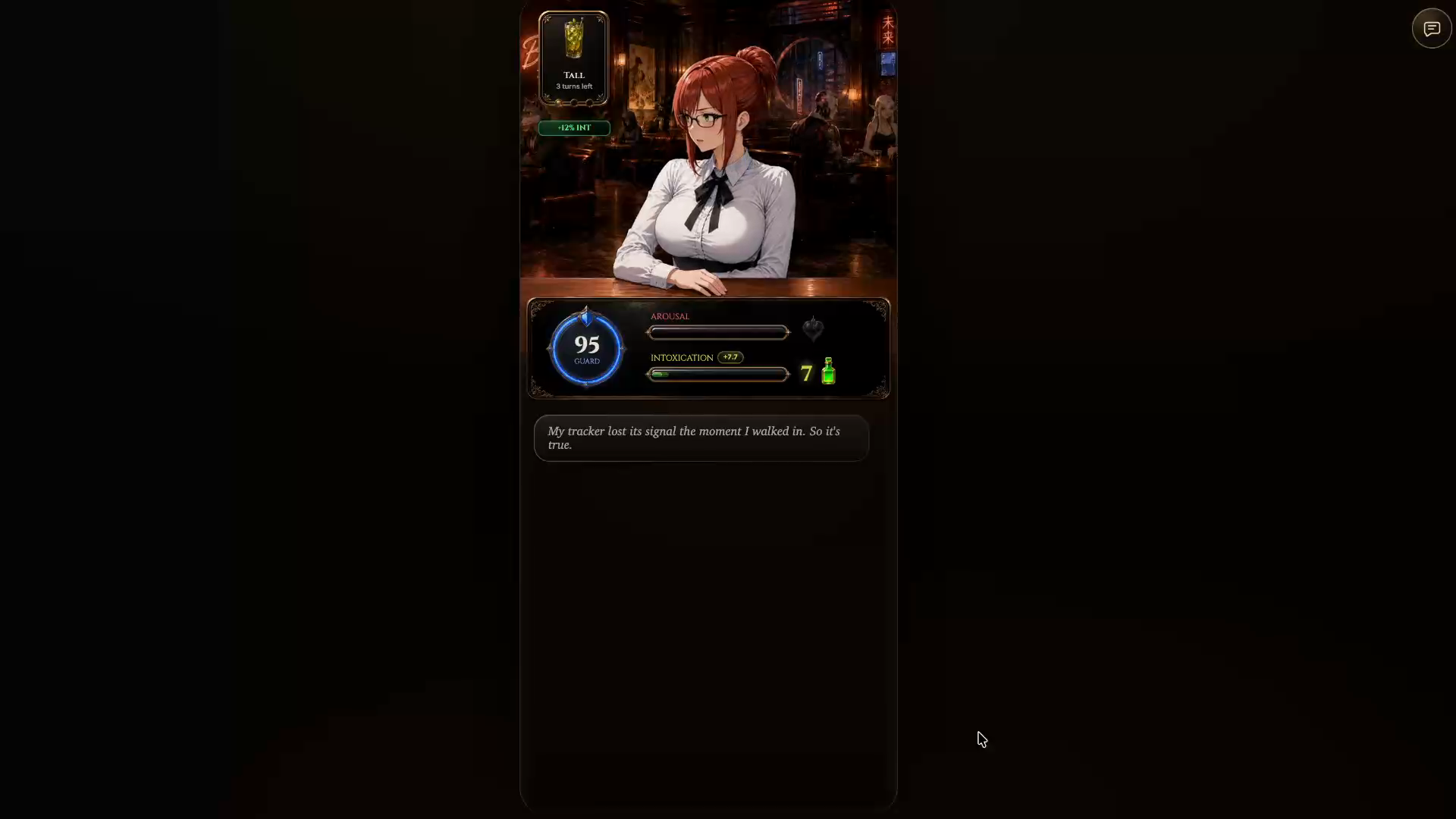
In Blindspot, the culmination of female agency is embodied in the transformative mechanic of Awakening. Unlike conventional video games where player choices simply dictate a companion's romance route or faction alignment, reaching Awakening represents an existential reckoning. Behind the shielded bar counter, as seen in the breakthrough gameplay moment (/media/blindspot/source-gameplay.png), the player uses tailored mixology and tactical dialogue cards (Insight, Joke, Flirt) to help patrons dismantle their protective Guard. However, the player cannot force an Awakening; the choice belongs entirely to the woman across the bar. Choosing Awakening means stepping into Lucid Authenticity—the courageous decision to reject corporate mood stabilizers, abandon curated social feeds, and live with raw, unfiltered emotional honesty. The cost of this agency is staggering: the woman's wellness tracker flashes red, her pristine Radiance score is irrevocably destroyed, and she becomes an outcast marked for corporate audits and disciplinary surveillance. Yet in making that sacrifice, she achieves total self-ownership. She is no longer an optimized asset designed for public consumption; she is a free, sovereign human being who has chosen truth over comfortable numbness. By elevating emotional vulnerability and radical honesty as the ultimate expressions of personal power, Blindspot charts a revolutionary path forward for the depiction of female agency in modern interactive storytelling.
Step into Blindspot and witness the next evolution of female agency in browser today
Sources & further reading
BLINDSPOT
Your shift is waiting.
Blindspot puts you behind the bar in the Risouverse. Talk to your guest, mix drinks, and watch how the conversation changes.
Play BlindspotRomantic Visual Novel · Browser demo · Sign-in required