
Games
Electric Chemistry: How Modern Games Build Reactive Female Companions That Feel Truly Alive
Explore how real-time behavioral reactivity, emotional friction, and systemic psychological combat transform companions in Mass Effect, Baldur's Gate 3, and Risouverse: Blindspot.

The Chemistry Paradox: Why Scripted Affection Often Rings Hollow
Romantic chemistry is one of the most notoriously elusive elements in video game design. For decades, interactive romance operated under a fundamentally flawed mechanical assumption: that intimacy is an additive progression bar. In conventional dating simulators and early role-playing games, building rapport with a female companion felt uncomfortably transactional. You selected the unambiguously supportive dialogue option, presented her favorite flowers or gemstones, and watched an affection meter tick upward until a scripted romantic cutscene triggered. While functional, this design created an uncanny emotional void. In real human relationships, romantic chemistry does not thrive on total agreement and frictionless deference; it sparks in the friction between two distinct worldviews, in shared laughter over unexpected absurdities, and in the mutual vulnerability required to lower one's guard. When a companion agrees with every word you say without hesitation, she ceases to feel like an authentic partner and begins to resemble a mirror designed to stroke the player's vanity. Furthermore, static dialogue trees frequently failed to register pacing, emotional context, or non-verbal subtext. Players could pivot abruptly from discussing traumatic wartime losses to brazen flirtation without the companion batting an eye. Modern narrative gaming has largely abandoned this simplistic model, recognizing that genuine narrative chemistry requires systemic reactivity—a dynamic web of behavioral feedback, emotional hesitation, and situational resistance that makes companions feel alive, perceptive, and wonderfully unpredictable.
Masters of the Spark: Banter, Friction, and History in Western RPGs
The journey toward authentic interactive chemistry found its early pioneers in character-driven Western role-playing games. BioWare set a towering standard throughout the Mass Effect trilogy through the unforgettable evolution of companions like Tali'Zorah and Liara T'Soni. What made these bonds resonate so deeply was not merely their grand romance climaxes, but the hundreds of casual elevator conversations, combat callouts, and ambient shipboard interactions that preceded them. Players watched Tali grow from an insecure Quarian youth on her Pilgrimage into an authoritative fleet admiral, with her affection for Shepard deepening organically across years of shared galactic trauma. More recently, Larian Studios raised the bar to unprecedented heights with Baldur's Gate 3. Characters like Karlach and Shadowheart possess an astounding degree of contextual reactivity. Karlach's romance, in particular, is an exhilarating masterclass in romantic tension: cursed with an overheating infernal engine that burns anyone who touches her, her longing for physical contact transforms simple proximity into an agonizing, electric dance. The game tracks not just dialogue choices, but physical positioning, camp resting states, and micro-reactions during major narrative revelations. When Shadowheart casts a guarded, lingering glance across a campfire or Karlach literally jumps with joy after a shared victory, the chemistry feels electrifying because it is woven seamlessly into the game's reactive systemic fabric.
The Counter as a Confessional: Architectural Intimacy in Bartending Sims
While epic role-playing games build chemistry across vast planetary battlefields, an entirely different school of narrative design discovered that the most intense emotional sparks occur in confined, stationary spaces. Landmark indie titles like Sukeban Games' VA-11 Hall-A and Toge Productions' Coffee Talk demonstrated the unique narrative alchemy of the counter interface. By placing a physical bar counter between the player and the guest, these games establish a captivating psychological dynamic. The counter acts as an architectural boundary that provides safety, professionalism, and physical detachment, yet paradoxically invites breathtaking personal confessions. Patrons who would never dream of discussing their private lives in public will readily unburden their souls to a bartender who knows how to listen. Furthermore, bartending simulators introduced a tactile mechanic that traditional dialogue wheels lacked: the drink as an emotional catalyst. The specific beverages you prepare alter a patron's mood, loosen rigid inhibitions, or evoke bittersweet nostalgia before a single word of conversation is spoken. This spatial and mechanical intimacy proves that romantic chemistry does not require saving the world; it can flourish within the quiet clinking of ice in a highball glass, the hum of neon signs in a rainy alley, and the charged silence between two people sharing a late-night drink.
Systemic Reactivity in Risouverse: Blindspot: Guard, Arousal, and Intoxication
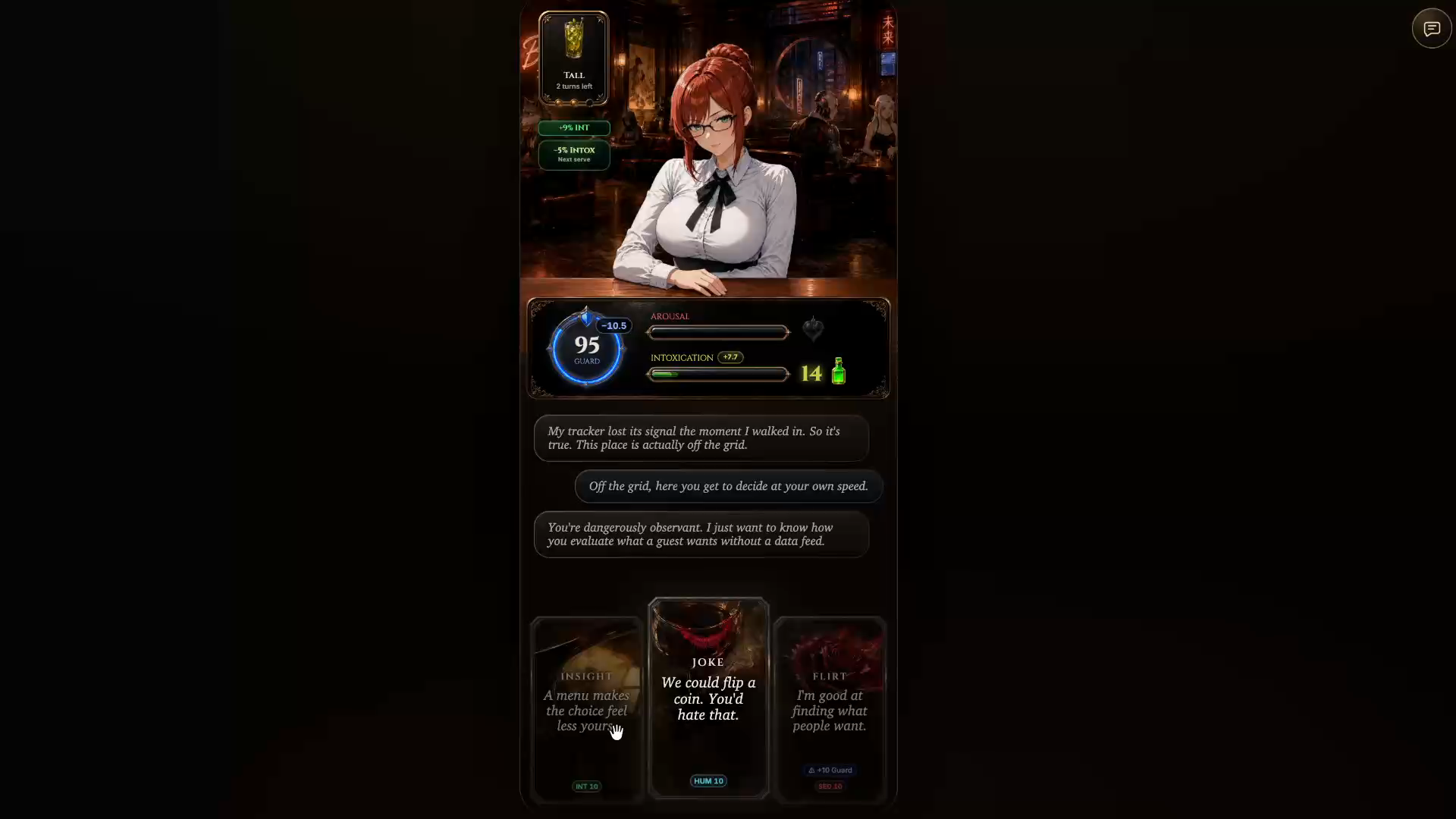
Risouverse: Blindspot elevates the bartending confessional into a sophisticated system of psychological combat where narrative chemistry is calculated in real time. Rather than relying on simple affinity scores, Blindspot simulates the patron's mental and physiological state through three interwoven metrics: Guard, Arousal, and Intoxication. As illustrated in the tactical dialogue UI (/media/blindspot/source-choices.png), the player responds to patrons using three distinct card archetypes: Insight, Joke, and Flirt. Guard represents the patron's corporate conditioning and emotional armor. If you attempt a bold Flirt card while a guest's Guard is high, she will instantly rebuff the advance with icy sarcasm, causing the room's tension to spike and emotional rapport to plummet. To build genuine chemistry with a woman like the high-ranking Celestial archivist Voss or the Therian enforcer Sable, you must first dismantle her defensive perimeter. Deploying an empathetic Insight card validates her unspoken corporate burdens, while a well-timed Joke diffuses defensive rigidity. Simultaneously, the bartender must craft bespoke cocktails using precise ratios of spirits and botanical mixers. Moderate Intoxication erodes Guard naturally, creating fertile windows where romantic advances land with electric intensity. However, over-serving a guest clouds her cognitive clarity and can trigger a devastating Cascade breakdown. Chemistry in Blindspot is a thrilling, finely calibrated dance between empathy, timing, and somatic awareness.
Somatic Feedback: Breathing Life into Lucid Authenticity
What cements Blindspot's romantic reactivity as a landmark achievement is its meticulous attention to visceral, somatic feedback. In the Pristine Cage, where every public emotion is monitored by corporate trackers, the physical body becomes the ultimate battleground for truth. In Blindspot, a patron's shifting psychological metrics are not abstract numbers hidden behind menus; they are reflected directly in her 2.5D character animations, vocal delivery, and subtle physiological cues. As Arousal rises and Guard crumbles, you witness breathtaking, nuanced shifts across the bar counter: a sudden hitch in Lexi's rhythmic breathing, the nervous involuntary twitch of Sable's copper feline ears, the delicate flush spreading across Voss's porcelain collarbones, or a sudden melodic glitch in vocal timbre as Lyra grapples with unscripted passion. These reactive micro-cues signal critical conversational windows, rewarding observant players who study sensory details rather than rushing blindly through dialogue prompts. You begin to understand that romantic chemistry is not an analytical formula; it is a live, somatic dialogue where hesitation carries as much weight as a spoken confession. When an encounter finally culminates in Awakening, the transformation is visceral, breathtaking, and permanent. The patron discards her corporate persona, accepts the terrifying consequences of ruined Radiance scores, and steps fearlessly into Lucid Authenticity. In that luminous moment of unfiltered intimacy, the romantic chemistry transcends clever game mechanics, delivering an unforgettable emotional breakthrough that proves the enduring artistic power of interactive narrative design.
Experience real conversational sparks and dynamic reactivity in Blindspot today
Sources & further reading
BLINDSPOT
Your shift is waiting.
Blindspot puts you behind the bar in the Risouverse. Talk to your guest, mix drinks, and watch how the conversation changes.
Play BlindspotRomantic Visual Novel · Browser demo · Sign-in required