
Games
Top Story-Rich Visual Novels and Interactive Fiction: Narrative Architecture, Deep Agency, and Emotional Resonance
Explore how story-rich visual novels and interactive fiction evolve from classic branching paths into deep psychological systems, spotlighting legends like Steins;Gate and the revolutionary mechanics of Risouverse: Blindspot.

The Architecture of Choice: From Linear Prose to Branching Odysseys
Interactive fiction occupies a unique crossroad between classic literature and game design. Where traditional novels invite passive observation, visual novels transform the reader into an active accomplice. In foundational masterworks like Steins;Gate, narrative branches are not playful diversions; they represent excruciating moral crucibles where altering causality ripples across worldlines, demanding agonizing emotional sacrifice. Steins;Gate brilliantly embedded this agency into a tactile physical action: answering or ignoring phone calls, grounding abstract narrative branch points in an everyday reflex. Key’s monumental Clannad similarly demonstrated that story-rich interactive fiction could evoke devastating pathos through domestic mundanity, constructing extensive relationship trees reflecting the cumulative weight of daily empathy and shared vulnerability. Meanwhile, Type-Moon’s legendary Fate/stay night redefined urban fantasy by utilizing three distinct narrative routes—Fate, Unlimited Blade Works, and Heaven’s Feel—to interrogate the philosophical contradictions of idealism and survivor's guilt from conflicting thematic angles.
Yet for decades, this branch-and-flag architecture relied almost exclusively on binary dialogue junctions: pick Option A to advance one heroine's affection meter, or pick Option B to trigger an abrupt bad ending. While narratively gripping, the mechanical interface remained fundamentally rigid. Players were navigating preordained decision trees rather than engaging in dynamic, psychologically responsive human relationships. As interactive storytelling matured, players and narrative designers began seeking systems where choices felt less like clicking through a paperback gamebook and more like navigating the volatile currents of authentic interpersonal communication, setting the stage for a profound evolution in modern narrative mechanics.
Subverting the Medium: When Games Challenge the Player's Psychology
Recent interactive fiction has pushed beyond conventional dialogue trees by challenging the player’s psychological perception and cognitive comfort. Slay the Princess brilliantly deconstructs narrative agency through existential horror and looping meta-dialogue, forcing players to interrogate their own assumptions as internal voices—such as the Voice of the Hero, the Paranoid, or the Stubborn—clash over the moral justification of violence. The game illustrates how player agency can itself become a trap when guided by unexamined prejudice or fear. In a parallel vein, Disco Elysium revolutionized conversational role-playing by turning the protagonist’s psyche into an argumentative committee of twenty-four conflicting internal voices, where raw somatic instincts, conceptualization faculties, and composure checks battle for conversational dominance.
Meanwhile, AI: The Somnium Files fuses traditional visual novel deduction with surreal dream-diving puzzles, requiring players to interpret subconscious symbolism and repressed memories rather than literal physical clues. These innovative titles proved that modern players hunger for genuine psychological friction: stories where characters do not simply wait for correct prompts, but actively push back, rationalize their trauma, and react to subtle conversational tone. Narrative depth is no longer measured solely by word count or static flowchart size; it is defined by emotional verisimilitude, cognitive dissonance, and the courage to depict flawed, unpredictable human consciousness. When a game respects a player's emotional intelligence, the boundaries between passive reading and immersive simulation dissolve completely.
Risouverse and the Pristine Cage: Dystopian Fiction Where Intimacy is Defiance
Entering this modern vanguard is Risouverse: Blindspot, an innovative cyberpunk narrative simulator that reimagines interactive fiction within a hauntingly plausible dystopia. Set three generations after The Softening—a historical crisis where an exhausted humanity willingly surrendered raw emotional autonomy in exchange for corporate stability—society exists inside the Pristine Cage. Here, five towering Megacorps curate every facet of existence: Lumina Veil manages public social feeds through algorithmic amplification and suppression; Vitalis Form enforces aesthetic bodily optimization; Vespera Serum manufactures mood stabilizers that smooth out all passionate volatility; Aegis Harmony maintains surveillance and civic compliance; and Nexus Forge builds frictionless synthetic infrastructure.
In this sun-drenched golden-hour utopia, deviance is never criminalized; it is simply scored down on your biometric wellness tracker and buried. Genuine passion, ugly grief, and desperate longing are treated as dangerous social pathogens. The ultimate rebellion takes place within the Blindspot Network: off-grid underground speakeasies shielded behind Static Wards where corporate trackers cannot reach. Behind the bar counter, players operate as Shadow Operators, welcoming weary corporate citizens who crave spaces where they can finally speak without their Radiance scores being audited. In a society that made sterile perfection mandatory, carving out a space for raw, messy truth becomes the most radical act possible, turning an intimate drink into an act of political subversion.
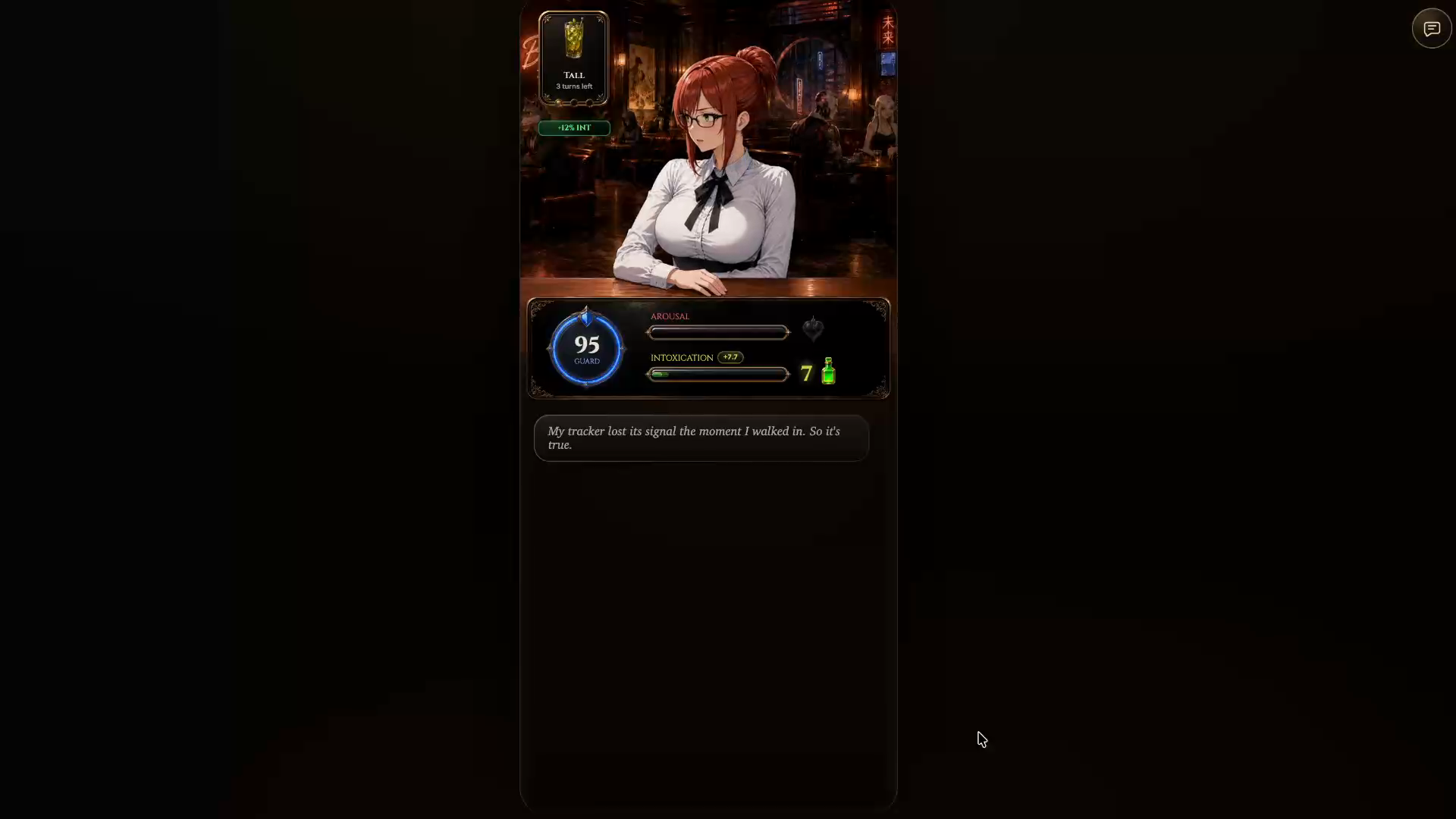
Beyond Dialogue Trees: Guard, Arousal, and Intoxication in Blindspot
Rather than relying on predictable binary choices, Blindspot models interpersonal connection through a dynamic triad of somatic and psychological metrics: Guard, Arousal, and Intoxication. Guard represents a patron's corporate psychological firewall—the reflexive skepticism and emotional armor honed over years of public surveillance and social scoring. When Guard sits above eighty percent, romantic or vulnerable advances are completely deflected with polite corporate detachment. Arousal measures genuine emotional engagement, romantic presence, and somatic chemistry. However, landing a romantic spark requires first eroding defensive barriers, as high Guard neutralizes incoming romantic gains and causes tender compliments to land awkwardly against guarded cynicism.
Intoxication serves as a double-edged chemical catalyst: as alcohol warms the patron's system, inhibitions soften and Guard naturally decays over successive turns, yet excessive drinks muddle cognition, reduce card potency, and risk conversational derailment. Players navigate this delicate equilibrium using an active hand of dialogue cards: Insight cards validate unspoken pain to chip away at Guard; Joke cards diffuse escalating defensive tension; and Flirt cards generate electric romantic heat when defenses have dropped. Simultaneously, players craft bespoke cocktails using distinct spirits and mixers, using ingredient properties to manipulate temperature, somatic relaxation, and emotional openness before deploying their next dialogue card, transforming routine bar shifts into tactical psychological duels where every choice shifts the patron's emotional state.
The Pursuit of Lucid Authenticity: Why Story-Rich Fiction Must Evolve
The emotional climax of any shift in Blindspot lies in guiding patrons toward Lucid Authenticity: the radical decision to cease medicating, drop the corporate performance, and articulate raw, unfiltered truth. Patrons like Voss—a brilliant Lumina Veil media strategist masking acute burnout behind cynical wit—must be carefully guided past defensive rationalizations. Lexi, a radiant Vitalis Form athletic coach, suffocates under mandatory corporate cheerfulness while yearning for permission to fail and be weak without social judgment. Sable, an Aegis Harmony liaison of Therian lineage, struggles against chemical dampeners that dull her heightened feral senses into a numb haze, aching for genuine tactile friction and uninhibited presence.
By pairing perceptive cocktail alchemy with high-stakes card choices, players dismantle their protective masks. Awakening is not a simple victory lap or a superficial stat bonus; it demands true sacrifice, as letting one's Guard collapse means accepting the social cost of a plummeting Radiance score in exchange for genuine human connection. Blindspot demonstrates how visual novels can transcend passive reading, delivering a browser-playable experience where every conversation is an intimate, high-stakes duel for the human soul, bridging high-concept cyberpunk literature with deeply satisfying mechanical agency. In doing so, it proves that story-rich interactive fiction can challenge players emotionally while offering deep systemic gameplay.
Step behind the counter and experience Risouverse: Blindspot directly in your browser
Sources & further reading
BLINDSPOT
Your shift is waiting.
Blindspot puts you behind the bar in the Risouverse. Talk to your guest, mix drinks, and watch how the conversation changes.
Play BlindspotRomantic Visual Novel · Browser demo · Sign-in required